


Probiotics Powder
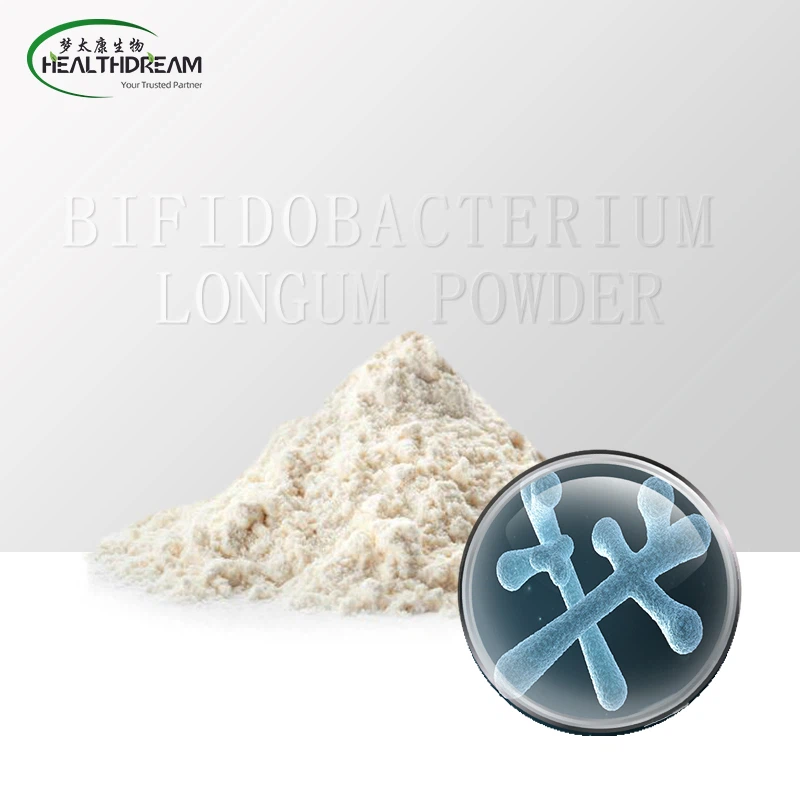
Bifidobacterium Longum
Bifidobacterium longum is one of the most abundant Bifidobacterium species in the intestinal tract of healthy humans, with excellent gastric acid tolerance and intestinal colonization ability.By regulating intestinal flora balance, strengthening intestina
Description


How to Select Bifidobacterium longum?
The key to selecting Bifidobacterium longum lies in three dimensions: strain specificity, viable cell count, and safety certification.
1. Strain Selection
Different strains vary significantly in function. Choose well-documented strains supported by clinical research, such as BB536 (immune regulation, intestinal health), M-63 (infant intestinal health), YLGB-1496 (pediatric immune support), etc. The efficacy of these strains has been verified by numerous human studies.
2. Viable Cell Count
Select products with a clearly labeled viable cell count at the end of shelf life. Probiotics degrade during storage and passage through gastric acid. A viable count of ≥1 billion CFU per serving at the end of shelf life is the basic guarantee for an effective dose. For infant formulas, compliance with regulatory standards of the target market is required.
3. Safety Certification
Bifidobacterium longum (e.g., BB536) has a safety track record of more than 40 years, is certified as GRAS by the U.S. FDA, and is listed in China’s List of Strains Available for Infant Food. Choosing raw materials with complete regulatory compliance documents ensures smooth market access for your products.
4. Dosage Form and Processability
Bifidobacterium longum is suitable for various dosage forms including capsules, powders, infant formula, and drops. Raw materials produced with freeze-drying or microencapsulation technology ensure viable cell stability during ambient storage and processing.
5. Formula Compatibility
For multiple benefits, products formulated with prebiotics (such as fructooligosaccharides) or other probiotic strains can be chosen to achieve synergistic effects. We provide formulation recommendations and stability data support.

| Product Name: | Bifidobacterium longum probiotic powder |
| Strain name: | Bifidobacterium longum |
| Specification: | 10 billion CFU/g |
| Type: | Freeze dried powder |
| Packing: | Heat sealing aluminum foil bag, 1kg/5kg |
| Storage: | Cold freeze condition, better under -18 oC |
| Shelf li fe: | At least 24 months when proper stroaged |
| Qualification:: | ISO9001; FSSC20000; Kosher; Halal |
| Statements: | NON-GMO; Lactose Free; Dairy Free; Gluten Free; Allergy Free |
| No preservative, flavoring or coloring is added | |
| Adavantages: | Gastric acid& Bile Resistant; Shelf Stable |

1. Enhances Immune Function
Bifidobacterium longum is a well recognized immune supporting probiotic.After 5 weeks of continuous intake of the flagship strain BB536, NK cell activity and neutrophil bactericidal activity were significantly improved in elderly subjects, accompanied by a marked reduction in the incidence of influenza and fever. A 2023 study further confirmed that BB536 exerts immunomodulatory effects in healthy adults by activating plasmacytoid dendritic cells (pDC).In pediatric populations, clinical trials of strain YLGB 1496 showed that the incidence of upper respiratory tract infections in the supplemented group was only 34.0%, significantly lower than 58.0% in the placebo group. The incidence of cough, fever, bronchopneumonia, and eczema was also notably reduced.
2. Regulates Intestinal Microbiota and Improves Constipation
Bifidobacterium longum effectively balances the gut microbiota by competitively inhibiting pathogenic bacterial adhesion and producing short chain fatty acids through metabolism to lower intestinal pH.Its excellent gastric acid tolerance and intestinal colonization ability allow it to successfully colonize the colon in a viable state. Studies in patients with functional constipation demonstrate that supplementation with Bifidobacterium longum significantly increases defecation frequency, softens stools, relieves difficulty in defecation, and reduces digestive discomfort such as bloating and abdominal pain. It is especially suitable for maintaining intestinal health in middle aged and elderly individuals.
3. Strengthens Intestinal Barrier Function
Bifidobacterium longum enhances the tightness of junctions between intestinal epithelial cells and reduces intestinal permeability by upregulating the expression of intestinal tight junction proteins (e.g., occludin, ZO 1), effectively preventing “leaky gut”.This function blocks endotoxins, undigested macromolecules, and pathogens from entering the bloodstream, reducing systemic inflammation at the source. It provides adjunctive improvement for intestinal disorders including inflammatory bowel disease and irritable bowel syndrome.
4. Supports Healthy Development in Infants and Young Children
Bifidobacterium longum (especially subspecies infantis strains M 63, YLGB 1496, etc.) is listed in China’s List of Strains Available for Infant Food and widely used in infant formula and probiotic drops.It helps formula fed infants establish an intestinal microbiota structure similar to that of breastfed infants. Clinical research confirms that it significantly reduces the risk of diarrhea, eczema, and atopic dermatitis in infants and young children, supports the maturation of intestinal barrier function and immune system development, making it one of the most widely used probiotics in infant health.
5. Alleviates Allergic Symptoms
Bifidobacterium longum shows valuable applications in allergy management by regulating Th1/Th2 immune balance and reducing excessive activation of Th2 mediated immune responses.Clinical studies indicate that specific strains can lower allergen specific IgE levels and improve symptoms of atopic diseases such as eczema and allergic rhinitis. It is particularly effective in preventing and relieving allergies in infants and young children, making it an ideal choice for allergy management formulations.
6. Promotes Nutrient Absorption and Synthesis
Bifidobacterium longum participates in the synthesis of B vitamins and vitamin K, and increases the solubility and absorption of minerals including calcium, magnesium, and iron by lowering intestinal pH.It produces β galactosidase to help break down lactose and alleviate lactose intolerance. This function provides important nutritional support for infants, young children, the elderly, and individuals with sensitive digestion.

1. Well-Identified Flagship Strains
Bifidobacterium longum includes several globally renowned flagship strains. Among them, BB536 is one of the most extensively researched bifidobacterial strains, with over 40 years of safe use history and support from more than 180 clinical studies.It has a clear strain deposit number and well-defined genetic background. Complete strain identification reports (16S rRNA sequencing) and traceability information are available, ensuring reliable raw material sources and controllable quality.
2. Strong Resistance to Gastric Acid and Bile
Bifidobacterium longum exhibits excellent gastrointestinal tolerance, enabling it to pass through the acidic gastric and bile environments as viable bacteria and successfully colonize the colon.This characteristic ensures stable probiotic efficacy and serves as a key guarantee for “live bacteria reaching the intestine” in formulation design, making it particularly suitable for demanding applications such as infant formula where high viable bacteria survival rate is required.
3. Excellent Intestinal Colonization Ability
Bifidobacterium longum is one of the most abundant bifidobacterial species in the healthy human gut, capable of stably adhering to and colonizing the intestinal mucosal surface.After colonization, it can maintain intestinal microbial balance over the long term, continuously supporting intestinal health by competitively inhibiting harmful bacteria and promoting the growth of beneficial strains.
4. Immune Support and Anti-Infective Effects
Bifidobacterium longum is a widely recognized immune-supporting probiotic.Clinical studies confirm that BB536 significantly enhances NK cell activity and neutrophil bactericidal activity in the elderly, reducing the incidence of influenza and fever; YLGB-1496 reduces the incidence of upper respiratory tract infections in children. Its immunomodulatory effects have been clearly verified across multiple age groups.
5. High Safety and Complete Regulatory Compliance
Bifidobacterium longum (especially strain BB536) obtained U.S. FDA GRAS certification for use in infant formula in 2019, and subspecies infantis M-63 was approved for full-term infant formula in 2022.It is listed in China’s List of Strains Available for Infant Food and suitable for both infants and the general population. A full set of regulatory compliance documents is provided to meet market access requirements in major global markets.
6. Excellent Stability and Processability
Bifidobacterium longum produced using freeze-drying and microencapsulation technologies shows controllable viable bacteria decay under ambient storage and stable viable count throughout its shelf life.It is suitable for various dosage forms including capsules, powders, tablets, drops, infant formula, fermented dairy products, and functional beverages, with excellent processability supporting dry blending and low-temperature processing.
7. Synergistic Multiple Functions
Bifidobacterium longum is not a single-function probiotic, but offers multiple benefits including regulating intestinal flora, strengthening the intestinal barrier, activating the immune system, improving constipation, alleviating allergies, and promoting nutrient absorption.This multi-target mechanism makes it a core strain choice in complex probiotic formulations.
8. Good Compatibility in Synergistic Formulations
It shows excellent compatibility with prebiotics (fructooligosaccharides, inulin) and other probiotic strains (such as Bifidobacterium animalis, Lactobacillus rhamnosus, Lactobacillus acidophilus, etc.) without antagonistic effects.Formulation recommendations and stability data support are available, making it ideal for building comprehensive intestinal health solutions.

Q1: Is Bifidobacterium longum suitable for infants and young children?
A: Yes. Bifidobacterium longum (especially subspecies infantis strains M‑63 and YLGB‑1496) is included in China’s List of Strains Available for Infant Food. Strain BB536 was granted FDA GRAS status for use in infant formula in 2019.It is suitable for infant formula, complementary foods and probiotic drops, helping to establish a healthy gut microbiota and reduce the risk of allergies and infections.
Q2: What is the difference between Bifidobacterium longum and Bifidobacterium animalis?
A: Both belong to the genus Bifidobacterium but have different functional focuses.Bifidobacterium longum is one of the most abundant species in the healthy human gut and excels in immune regulation, allergy relief, and supporting infant development.Bifidobacterium animalis (such as BB‑12) has more extensive research in intestinal health and constipation improvement.They can be used synergistically to create a more comprehensive probiotic formulation.
Q3: What are the advantages of combining Bifidobacterium longum with prebiotics?
A: Prebiotics (such as fructooligosaccharides and inulin) serve as specific nutrients for Bifidobacterium longum. When combined, they promote its colonization and proliferation in the gut, achieving synergistic effects of “probiotics + prebiotics” that are superior to single use. This is a common formulation strategy for high‑end probiotic products.
