


Probiotics Powder
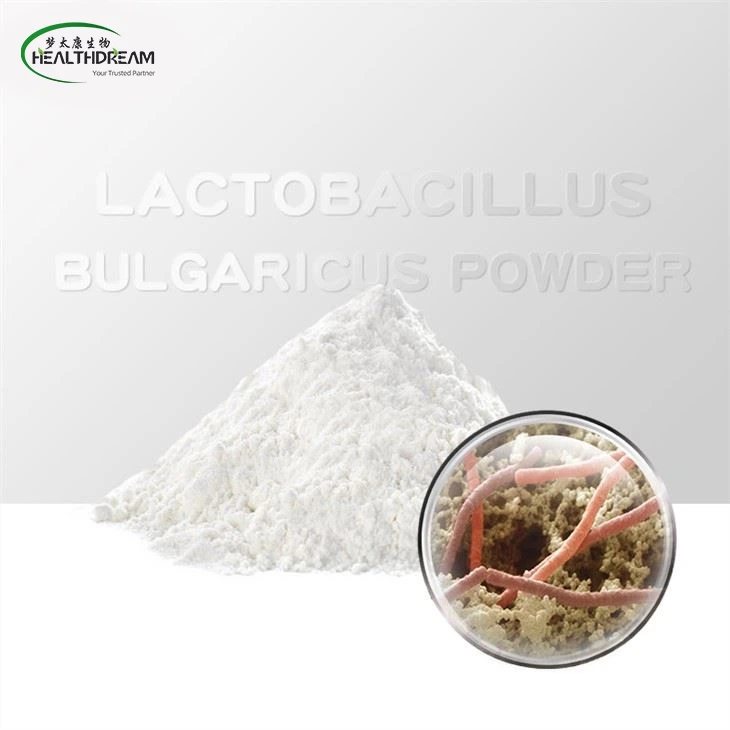






Lactobacillus Bulgaricus powder
Lactobacillus bulgaricus is a key strain in traditional yogurt fermentation. It symbiotically ferments with Streptococcus thermophilus to produce lactic acid, giving yogurt its unique flavor and texture. It helps break down lactose to relieve lactose into
Description


Is Lactobacillus bulgaricus helpful for lactose intolerance?
During fermentation, Lactobacillus bulgaricus produces a large amount of β-galactosidase (lactase), which breaks down lactose into glucose and galactose. As a result, the lactose content in yogurt after long-term fermentation can be reduced by 20%–30% or even more, making it easier for people with lactose intolerance to digest and absorb.
In addition, viable bacteria can still temporarily secrete lactase after entering the intestinal tract to assist in breaking down residual lactose, thereby relieving symptoms such as bloating and diarrhea.
It should be noted that not all products containing Lactobacillus bulgaricus are effective. Yogurt with sufficient viable bacteria and adequate fermentation yields better results.

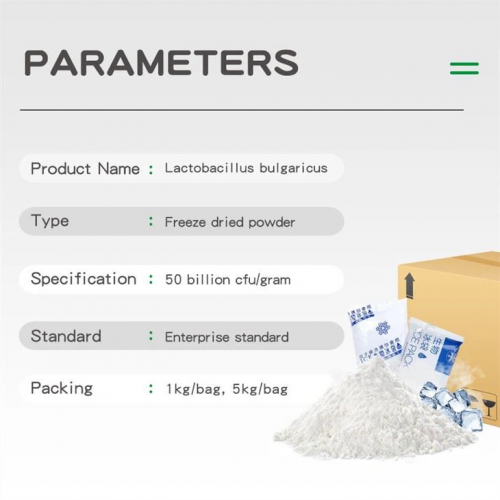
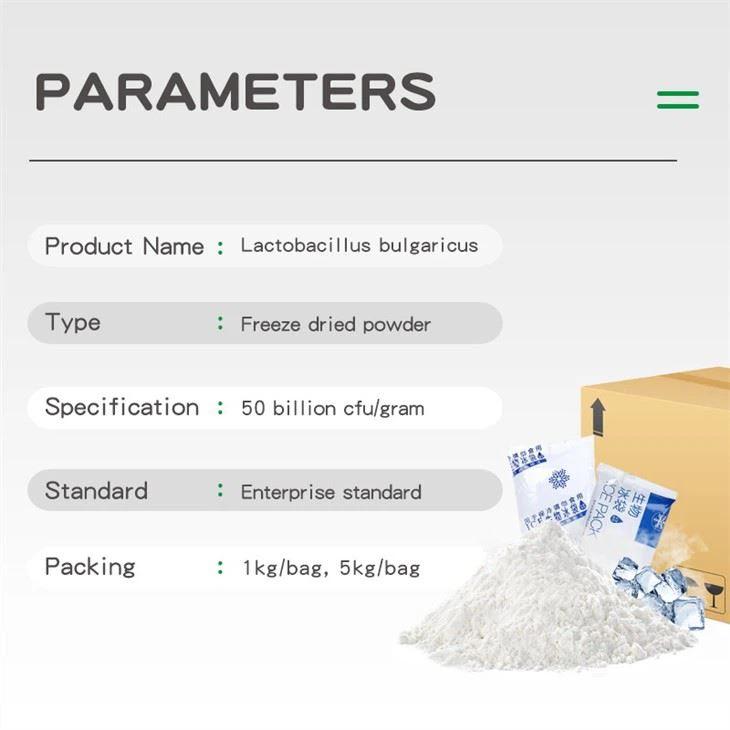
| Product Name: | Lactobacillus bulgaricus Powder |
| Strain name: | Lactobacillus bulgaricus |
| Strain identification: | Characteristic by API 50CH&16S rDNA |
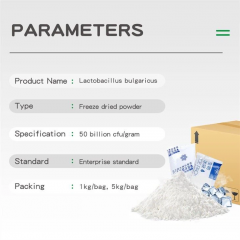
| Type: | Freeze dried powder |
| Packing: | 1kg/bag, 5kg/bag in cold-chain package |
| Storage: | Package sealed at 4℃ or refrigeration - 18℃ |
| Shelf life: | 24 months from date of production |
| Certfication: | NSF, HACCP, ISO9001, Kosher, HALAL |
| Documents support: | Genetic identification report |
| IDA deposit certificate | |
| Certificate of analysis | |
| Stability study report | |
| Anti-bile salt & Anti gastro-acid study report | |
| Antibiotic sensitivity test certificate | |
| Safety study report | |
| Microbial Enumeration method |

| Descrption: | Fine powder, no caking, no abnormal odor, no visible foreign bod |
| Color: | White to light yellow |
| Mositure: | NMT 5.0% |
| Water activity: | < 0.12% |
| Viable cell count: | NLT 50 billion cfu/gram |
| Non LAB count: | < 5000 cfu/g |
| Yeast &mould: | NMT 50 cfu/g |
| Coliform: | < 10 cfu/g |
| Pathogenic bacteria: | Negative |
| Lead(Pb): | NMT 0.5 mg/kg |
| Arsenic(As): | NMT 0.5 mg/kg |
| Cadmium(Cd): | NMT 1.0 mg/kg |
| Mercury(Hg): | NMT 0.1 mg/kg |

1. Core Strain in Traditional Fermentation
It forms a classic symbiotic relationship with Streptococcus thermophilus. The former provides amino acids and peptides, while the latter supplies carbon dioxide and formic acid, mutually promoting growth. Its fermentation efficiency is much higher than that of single-strain culture.
2. Strong Acid Resistance
It grows well in a low-pH environment (4.0–5.0). It metabolizes and produces large amounts of lactic acid, enabling it to tolerate its own acidic metabolites, and remains active in the late stage of yogurt fermentation.
3. Fast Acid Production
It ferments lactose to produce L-lactic acid at around 42°C, lowering the pH of milk to below
4.5 within 4–6 hours, allowing rapid coagulation to form a yogurt gel.
4. Exopolysaccharide Production
Some strains can produce exopolysaccharides, which give yogurt good viscosity and a smooth mouthfeel, reduce the use of stabilizers, and meet clean-label requirements.
5. Oxygen Sensitivity
It is microaerophilic or anaerobic, and its growth is inhibited in an aerobic environment. Commercial production requires control of oxygen exposure, typically using submerged fermentation or the addition of reducing agents.
6. Temperature Sensitivity
Its optimal growth temperature is 40–43°C. Growth slows below 37°C and it is rapidly inactivated above 50°C. It is suitable for temperature-controlled fermentation processes but not for addition after high-temperature sterilization.
7. Processing Adaptability
It is supplied as a freeze-dried powder and can withstand freeze-drying. However, it is highly heat-sensitive and unsuitable for high-temperature granulation or addition after pasteurization. It is commonly used as a starter culture for fermented dairy products or post-added to low-temperature products.

1. Lactose Breakdown and Improvement of Lactose Intolerance
Lactobacillus bulgaricus produces β galactosidase, which hydrolyzes lactose into glucose and galactose, reducing lactose content in yogurt by 20%–30%. Viable bacteria continue to produce enzymes in the intestine, relieving bloating and diarrhea in people with lactose intolerance, and reducing the positive rate of hydrogen breath tests by approximately 50%.
2. Acid Production via Fermentation and Natural Food Preservation
In symbiotic fermentation with Streptococcus thermophilus, it rapidly produces L lactic acid to lower the pH below 4.5, coagulates casein, and inhibits pathogenic bacteria such as Escherichia coli and Salmonella. The refrigerated shelf life of yogurt can reach 21–28 days, reducing the use of chemical preservatives.
3. Regulation of Intestinal Microflora Balance
It inhibits harmful bacteria through competitive adhesion, bacteriocin production, and organic acid secretion. It increases beneficial bacteria such as Bifidobacterium and Lactobacillus by 1–2 log levels, reduces opportunistic pathogens including Clostridium perfringens, and restores microbial imbalance caused by antibiotics or diarrhea.
4. Bidirectional Regulation to Relieve Diarrhea and Constipation
It inhibits pathogens, repairs the intestinal barrier, and regulates intestinal peristalsis. Clinical studies show that the course of acute infectious diarrhea is shortened by about 1 day; the duration of diarrhea in children is reduced from 3.5 days to 2.2 days; and functional constipation is improved with increased defecation frequency.

Q1: What is the difference between Lactobacillus bulgaricus and Streptococcus thermophilus?
A: Lactobacillus bulgaricus is the main acid-producing strain in yogurt fermentation, generating L-lactic acid; Streptococcus thermophilus provides flavor compounds and growth-promoting factors. They have a symbiotic relationship, and ideal fermentation results cannot be achieved when used alone.
Q2: Can Lactobacillus bulgaricus improve lactose intolerance?
A: Yes. It produces lactase during fermentation to break down lactose, and viable bacteria continue to assist digestion after entering the intestinal tract. Clinical studies show that yogurt containing Lactobacillus bulgaricus significantly relieves symptoms of lactose intolerance.
Q3: Who is Lactobacillus bulgaricus suitable for?
A: It is mainly suitable for people with lactose intolerance, those who need to regulate intestinal flora (such as after antibiotic use), and consumers seeking health benefits from traditional fermented foods. It is also widely used as a starter culture in the dairy industry.
Q4: What is the standard for viable count of Lactobacillus bulgaricus?
A: As a starter culture, the inoculation rate is usually 10⁶–10⁷ CFU/mL of milk. As a probiotic supplement, a daily intake of ≥10⁹ CFU is recommended. We provide test reports for viable count in freeze-dried powder, and different concentrations can be customized.
Q5: What should be noted during the processing of Lactobacillus bulgaricus?
A: This strain is sensitive to high temperatures. Processing temperature is recommended to be ≤45°C to avoid high-temperature sterilization processes. Freeze-dried powder should be stored sealed and away from light, and used as soon as possible after opening. Fermented dairy products require cold-chain transportation to maintain viable bacterial activity.
