


Probiotics Powder
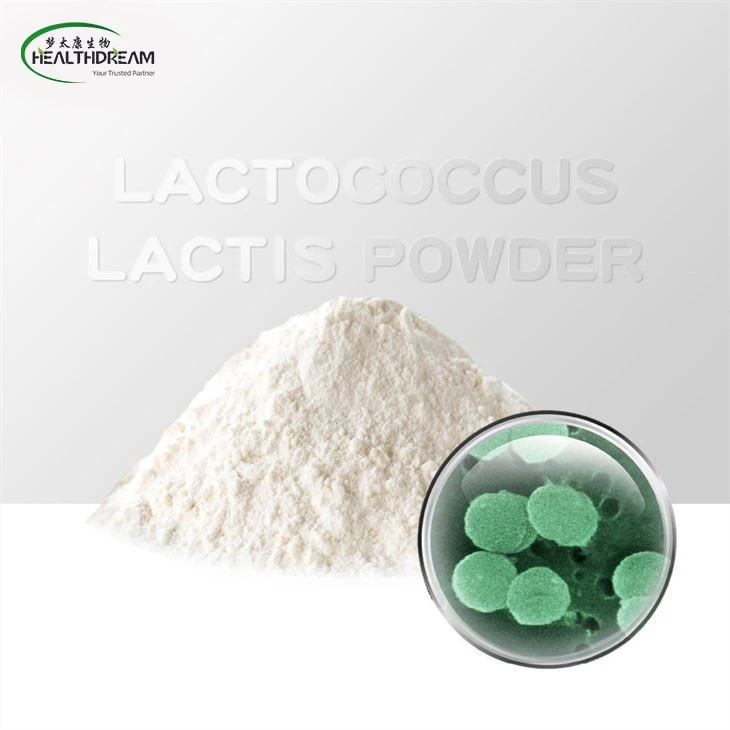






Lactococcus lactis powder
Lactococcus lactis is one of the most crucial strains in the dairy fermentation industry. It is widely used in the production of fermented dairy products such as sour cream, buttermilk and cheese.It rapidly produces acid to lower pH, inhibits spoilage bac
Description


How is the processing tolerance of Lactococcus lactis?
Overall, Lactococcus lactis has relatively weak processing tolerance and is sensitive to heat, acid, bile salts, and oxidative stress, although significant differences exist among strains. Its adaptability can be greatly improved through microencapsulation.
Moderately weak heat resistance:
Subsp. cremoris cannot grow at 45°C, with a typical survival rate of approximately 20% during spray drying. Heat-adaptive culture (increasing temperature by 3–5°C) can improve survival by 0.7–1.5 log. Subsp. lactis is generally more heat-tolerant than subsp. cremoris.
Limited acid and bile salt resistance:
Gastric acid tolerance is generally weaker than that of Lactobacillus. Some strains (e.g., NCU036015) show a survival rate >87% after 3 hours in gastric juice at pH 3.0, and >83% after 4 hours in 0.1% bile salts. Strain selection is critical.
Microencapsulation significantly improves tolerance:
After sodium alginate microencapsulation, the survival rate decreases by only 25.5% under gastric acid exposure (vs. 48% for free cells) and by 31.8% under bile salt exposure (vs. 59.6% for free cells), representing an approximately 68% higher survival rate than free bacteria. Combined with protectants (sucrose + ascorbic acid), the survival rate of sensitive strains can be increased from 10² to 10⁶ CFU/g.
Freeze-drying is superior to spray-drying:
Freeze-drying causes less cell damage and is the preferred process. Spray-drying requires heat-resistant strains combined with heat-adaptive culture.

| Product Name: | Lactococcus lactis Powder |
| Strain name: | Lactococcus lactis |
| Strain identification: | Characteristic by API 50CH&16S rDNA |
| Type: | Freeze dried powder |
| Packing: | 1kg/bag, 5kg/bag in cold-chain package |
| Storage: | Package sealed at 4℃ or refrigeration - 18℃ |
| Shelf life: | 24 months from date of production |
| Certfication: | NSF, HACCP, ISO9001, Kosher, HALAL |
| Documents support: | Genetic identification report |
| IDA deposit certificate | |
| Certificate of analysis | |
| Stability study report | |
| Anti-bile salt & Anti gastro-acid study report | |
| Antibiotic sensitivity test certificate | |
| Safety study report | |
| Microbial Enumeration method |

| Descrption: | Fine powder, no caking, no abnormal odor, no visible foreign bod |
| Color: | White to light yellow |
| Mositure: | NMT 5.0% |
| Water activity: | < 0.12% |
| Viable cell count: | NLT 500 billion cfu/gram |
| Non LAB count: | < 5000 cfu/g |
| Yeast &mould: | NMT 50 cfu/g |
| Coliform: | < 10 cfu/g |
| Pathogenic bacteria: | Negative |
| Lead(Pb): | NMT 0.5 mg/kg |
| Arsenic(As): | NMT 0.5 mg/kg |
| Cadmium(Cd): | NMT 1.0 mg/kg |
| Mercury(Hg): | NMT 0.1 mg/kg |

1.Dairy Fermentation and Curdling
Lactococcus lactis is a core strain in fermented dairy products such as sour cream, cheese and buttermilk. It rapidly produces acid to lower the pH of milk to below 4.6, coagulates casein to form curd, and gives products their characteristic sour taste and texture.
2.Natural Food Preservation
Some strains (such as ATCC 11454) produce nisin, a bacteriocin that effectively inhibits spoilage and pathogenic bacteria including Listeria, Staphylococcus aureus and Bacillus. It is widely used for natural preservation in dairy products, canned goods, meat products and other foods, meeting clean-label requirements.
3.Regulation of Intestinal Flora
Lactococcus lactis regulates intestinal microecological balance and promotes the proliferation of beneficial bacteria through competitive inhibition of pathogenic bacteria and production of organic acids and antibacterial substances, helping relieve diarrhea and improve digestive function.

1. Fast Acid Production
Its optimal growth temperature is 30°C. It rapidly ferments lactose to produce L-lactic acid, reducing the pH of milk to below 4.5 within 4–6 hours, making it a highly efficient dairy starter culture.
2. Bacteriocin Production Capacity
Star strains (such as ATCC 11454) produce nisin, which exhibits strong inhibitory activity against Gram-positive bacteria and has been commercially applied for food preservation in more than 50 countries.
3. Significant Functional Differences Among Strains
Lactococcus lactis is divided into subsp. lactis and subsp. cremoris. The former is more heat-tolerant and produces acid faster, while the latter generates better flavor. Functional traits including bacteriocin production, acid tolerance, and adhesion ability can vary by up to 1000-fold between different strains.

Q1: What is the difference between Lactococcus lactis and Lactobacillus?
A: They belong to different genera. Lactococcus lactis is a coccus mainly used for dairy fermentation and producing nisin as a preservative. Lactobacillus is a bacillus, more commonly used in probiotic supplements, with stronger acid tolerance and intestinal colonization ability.
Q2: Can Lactococcus lactis be consumed directly as a probiotic?
A: Yes, but it has relatively weak gastric acid tolerance. Strains with strong acid resistance or microencapsulation technology are required. Some strains (such as NCU036015) show a survival rate of >87% after 3 hours in gastric juice at pH 3.0 and can be directly used in probiotic products.
Q3: Who is Lactococcus lactis suitable for?
A: It is mainly suitable for people who need to improve digestive health and consumers who ingest viable bacteria through fermented dairy products. It is safe for children, adults and the elderly. Caution is advised for those allergic to milk protein.
