


Food & Beverage
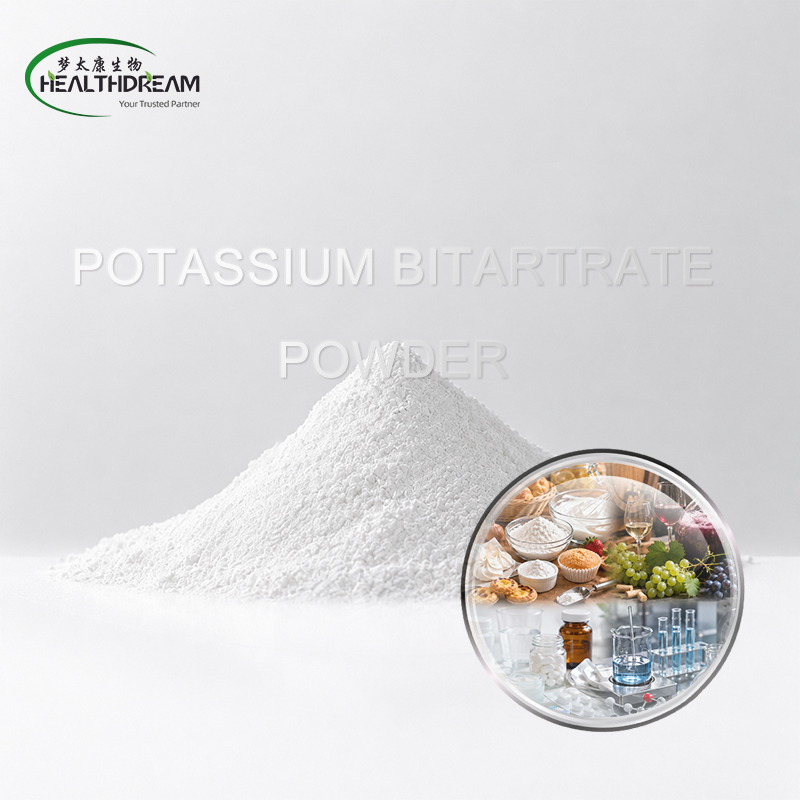
Potassium bitartrate Powder
Potassium bitartrate is the potassium acid salt of tartaric acid, commonly known in the food industry as cream of tartar. It typically appears as colorless to white crystalline powder with a pleasant, tart taste. It is naturally obtained as a byproduct of
Description

Why is Potassium Bitartrate a highly recommended choice for baking, pharmaceuticals, and food processing?
Derived from the natural crystallization of winemaking, Potassium Bitartrate offers excellent acid-base regulation and stabilization properties. In baking, it serves as a core component of natural acidic leavening agents, helping to stabilize meringues and enhance the fluffiness of baked goods. In the pharmaceutical sector, it is widely utilized as a safe pH buffering agent and a potassium supplement. In food processing, it not only helps prevent sugar crystallization in syrups but also contributes to improving food texture and appearance. With its natural origin, mild and odorless profile, and versatile functionality across multiple industries, it is an ideal ingredient for formulation upgrades.

| Purity | 99% |
| Appearance | White Powder |
| Certification | ISO9001/Halal/Kosher |
| Specification | 99% by HPLC potassium bitartrate |
| Dosage Form | Powder, Capsules, Tablets |
| Keywords | potassium bitartrate powder;potassium bitartrate price;wholesale potassium bitartrate |
| Storage | Keep in a cool, dry, dark location in a tightly sealed container or cylinder. |
| Shelf Life | 24 Months |

1.Food & Baking Industry: Serving as an acidic leavening agent, acidity regulator, and stabilizer, it is widely used in the production of baking powder, the stabilization of meringues, and the prevention of sugar crystallization in syrups.
2.Winemaking: As a natural byproduct in the winemaking process, it is frequently used to adjust the pH of the fermentation must and to prevent the precipitation of tartrate crystals after bottling.
3.Pharmaceuticals & Daily Chemicals: In the pharmaceutical sector, it is utilized as a buffering agent for pH adjustment and as an ingredient in mild laxatives. In daily chemical products, it serves as a natural exfoliating agent and a mild abrasive in toothpaste formulations.
4.Industrial & Laboratory Applications: Industrially, it is applied as a metal polish and a buffering agent in electroplating baths. In laboratory settings, it is commonly used in the preparation of buffer solutions and as a reducing agent for chemical analysis.

1.Unique Physicochemical Properties: At room temperature, it appears as a colorless to white crystalline powder with no odor and a pleasant, cooling sour taste. It is sparingly soluble in cold water and ethanol, but readily dissolves in hot water and dilute inorganic acids.
2.Natural Origin and Safety Profile: It is a natural byproduct of the winemaking process (commonly known as "cream of tartar" in the food industry). Recognized for its high safety profile, it has been designated as Generally Recognized As Safe (GRAS) by the FDA.
3.Outstanding Core Chemical Functionality: Its saturated aqueous solution is weakly acidic (with a pH of approximately 3.4–3.7) and exhibits excellent buffering capacity. It readily reacts with sodium bicarbonate to release gas, making it an ideal acidic leavening agent.
4.Strong Structural Stability: It demonstrates high chemical stability and is not prone to degradation at room temperature. However, it decomposes at elevated temperatures (above 200°C) and is incompatible with strong oxidizing agents.

Q1: What is Potassium Bitartrate, and how does it relate to Cream of Tartar?
A: Potassium Bitartrate is the acid salt of potassium tartrate. In the food industry and everyday baking, it is commonly referred to as "Cream of Tartar." It occurs naturally in grapes and is also a natural byproduct that precipitates during the winemaking process.
Q2: What is the primary role of Potassium Bitartrate in baking?
A: It is primarily utilized as an acidic leavening agent and a stabilizer. In baking, it is frequently combined with baking soda (sodium bicarbonate) to trigger an acid-base neutralization reaction that releases carbon dioxide, resulting in a light and fluffy dough. When making meringues, it helps lower the pH of the egg whites, thereby enhancing foam stability and preventing deflation.
Q3: What is the solubility profile of Potassium Bitartrate?
A: Its solubility is highly temperature-dependent. It is sparingly soluble in cold water and ethanol at room temperature, but its solubility increases significantly in hot water. Furthermore, it is readily soluble in dilute inorganic acids, alkaline solutions, and borax solutions.